How to Sell Online in Lebanon: Seven Decisions Before You Build Anything
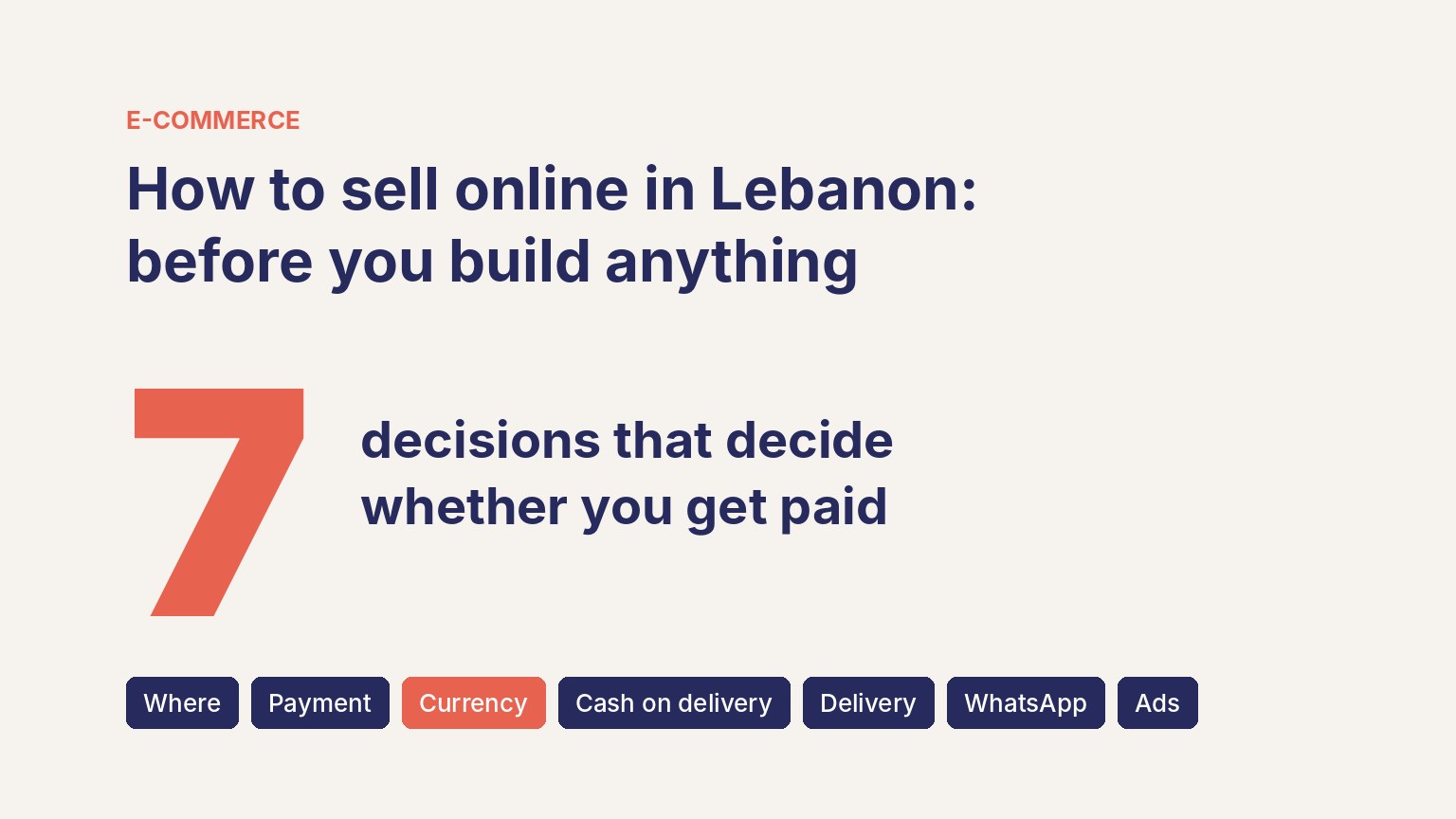
You can open a store in a weekend. What takes longer is deciding how you will be paid, delivered and found. Here are the seven decisions that matter, in order.
There are 6,414 live Shopify stores in Lebanon as of 30 October 2026. Two thirds of them sit in three categories: 2,043 in apparel, 1,293 in beauty and fitness, and 887 in home and garden, 4,223 stores in all. [1]
So the platform is the easy part. The decision that matters is what you sell and to whom. A new beauty store is entering a category that already has 1,293. A narrower product with a clear customer has far less company.
2. How you take payment
Shopify's own card processor, Shopify Payments, is available in 39 countries as of June 2026. Lebanon is not one of them. [2] You connect a third-party payment gateway instead.
There is a cost nobody mentions. Because you are not on Shopify Payments, Shopify charges its own fee on every order on top of the gateway's: 2% on the Basic plan, 1% on Grow and 0.6% on Advanced. [3] It appears on your Shopify invoice, not your gateway statement, so it is easy to miss.
3. What currency you price in
Most Lebanese stores price in US dollars. Shopify handles that without trouble. Google does not always. Google's own list of supported currencies shows the Lebanese pound as the only currency for Lebanon, so a dollar price can appear to shoppers converted into pounds. [4] Decide your currency before you set up ads, and see why it matters in Why Google Shows USD Prices in LBP in Lebanon.
4. What you do about cash on delivery
Cash on delivery is how many Lebanese customers pay. Byblos Horizon, the studio Mohamad runs, estimates from its store work that about 60% of orders are cash on delivery, and that 15% to 25% of those are refused at the door. Both are rough estimates, not measured figures, so check them against your own orders. [5]
A refused parcel costs you the delivery out, the delivery back and the ad that won the order. The cheapest fix is to confirm the order with the customer on WhatsApp before it ships, which is the setup in WhatsApp for Shopify Stores.
5. Who delivers
Across all 6,414 stores, a crawler can detect an international carrier on only 93, about 1.5%. [1] Almost everyone else runs on local couriers and arrangements no app sets up for you. Before you build, get written quotes for Beirut and for outside it, and ask what a returned parcel costs.
6. How customers reach you
Of the 6,414 stores, 4,123 show an Instagram link on the storefront and only 305 show WhatsApp, under 5%. [1] In a market where many sales are agreed in a chat, a visible WhatsApp number is the cheapest conversion tool you have, and most of your competitors have not added it.
7. What you spend on ads
Set the budget before you pick the channel, because the channels have different entry costs. Meta needs enough weekly results to learn, as Jad Al Masri explains in Meta Ads for Lebanese E-Commerce. TikTok sets a daily minimum of its own, covered in TikTok Ads in Lebanon. Google's Shopping ads depend on a country list you should read first, in Google Shopping Ads in Lebanon.
Before you build, write down
Your product and the one customer you are selling it to, in a single sentence.
The payment gateway you will use, and the extra Shopify fee on your plan.
The currency you will price in, and where it will be displayed.
Your cash on delivery rules: when you confirm on WhatsApp and when you refuse to ship.
A written delivery quote for Beirut and for outside it, including returns.
Your WhatsApp number, visible on every page.
A monthly ad budget you can afford to lose for three months.
These seven are the first half of the E-Commerce Mastery course, which then takes you through building the store, running the campaign and presenting real results.
Frequently asked questions
Yes. You can open a store on a platform such as Shopify, list products and take orders from Lebanon. The parts that differ are payment, because Shopify Payments is not available in Lebanon, and delivery, which mostly relies on local couriers.
No. Shopify Payments is available in 39 countries as of June 2026 and Lebanon is not on the list. Lebanese stores connect a third-party payment gateway, and Shopify charges an additional transaction fee of 2% on Basic, 1% on Grow and 0.6% on Advanced. Shopify's own list is the authority and can change.
Many pay cash on delivery. Byblos Horizon estimates that around 60% of orders are cash on delivery, in a range of 35% to 75%, alongside card payments through a third-party gateway. These are rough estimates from store operations.
Yes, but the difficult parts are collecting payments and getting paid, not building the store. Byblos Horizon has written guides on getting paid from Lebanon and on opening a US company to access payment tools. Read them before you spend on products or ads.
References
[1]Store Leads. Shopify Stores in Lebanon, dated 30 October 2026 For the store counts, the category counts and the detectable carrier, Instagram and WhatsApp figures. Store Leads counts detectable storefronts, not confirmed trading businesses.
[5]Byblos Horizon. Lebanon e-commerce cost calculator, methodology The 60% cash on delivery share and the 15% to 25% refusal range are Byblos Horizon's estimates from Lebanese store operations, labelled rough in the methodology.